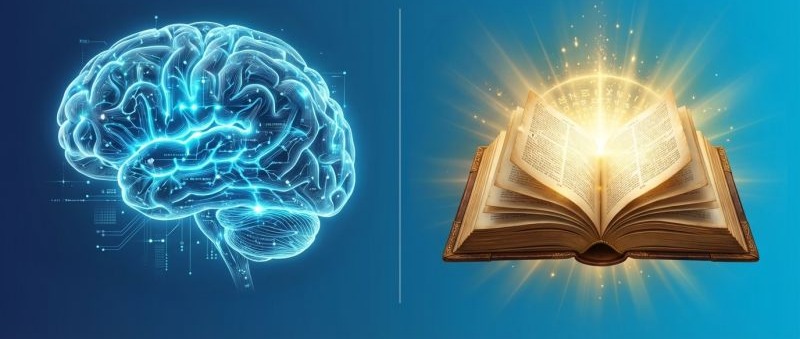
Where Neuroscience Meets Scripture
The Mind, the Brain, and the Bible: A Personal Reflection
When I began studying neuroscience, I often heard a statement that stayed with me:
“By the time you finish your degree, your faith will change.”
The message was clear. Many people believed that a deeper understanding of science would eventually lead me to question my faith or even abandon it altogether.
However, the opposite happened.
As I studied the brain, human behavior, cognition, and neuroplasticity, my faith became stronger. The more I learned about the complexity of the human mind and the nervous system, the more I appreciated the wisdom found in Scripture.
Instead of finding conflict between science and faith, I discovered many points of connection. Again and again, scientific discoveries appeared to support principles that the Bible had described thousands of years ago regarding thoughts, beliefs, emotions, behavior, and relationships.
Throughout my career as a neuro-informed physiotherapist and cognitive behavioral therapist, I have worked with more than a thousand individuals. During that time, I witnessed how powerful healing can become when neuroscience and faith work together.
Evidence-based interventions can create meaningful change. However, healing often becomes deeper when people connect their recovery journey to purpose, hope, and belief. As a result, transformation tends to be more resilient and long-lasting.
Modern neuroscience also shows that beliefs are not simply abstract ideas. Rather, they influence neural pathways, emotional regulation, perception, physiological responses, and behavior. Consequently, what we repeatedly think and believe shapes how we experience the world.
This is where neuroscience and Scripture meet in a remarkable way. Long before brain imaging and cognitive science existed, the Bible emphasized the importance of renewing the mind, guarding thoughts, and living according to truth.
Science continues to grow and refine our understanding of the brain. Meanwhile, Scripture remains unchanged. Instead of finding contradiction between the two, I have often found that scientific discoveries shed new light on timeless biblical principles.
For me, neuroscience has not weakened my faith. On the contrary, it has deepened my appreciation for the extraordinary design of the human mind and the enduring wisdom of God’s Word.
The Ancient Blueprint: What Scripture Teaches About Thoughts and Behavior
Long before psychology and neuroscience emerged, Scripture emphasized an important truth: our inner world shapes our outer life.
The Bible consistently teaches that thoughts, beliefs, attitudes, and motivations influence emotions, choices, and actions.
“As a man thinks in his heart, so is he.” — Proverbs 23:7
“Be transformed by the renewing of your mind.” — Romans 12:2
“For from within, out of the heart of men, proceed evil thoughts.” — Mark 7:21
From Genesis to Revelation, transformation is presented as an inside-out process. Lasting change does not begin with behavior alone. Instead, it begins with the renewal of the heart and mind.
In biblical language, the heart represents far more than emotions. It includes beliefs, values, intentions, and convictions. Therefore, what we believe becomes the lens through which we interpret reality.
In many ways, our belief systems function like an internal operating system. They influence perception, guide decisions, and shape responses to life’s challenges.
Interestingly, the Bible highlighted this principle long before modern science began exploring the biological mechanisms behind it.
The Science of Belief and Behavior
For many years, scientists believed that the adult brain was largely fixed and unable to change significantly.
Today, that view has changed dramatically.
One of the most important discoveries in modern neuroscience is neuroplasticity. This term refers to the brain’s ability to reorganize itself and create new neural pathways throughout life.
As a result, our understanding of learning, emotional healing, habit formation, and personal growth has changed significantly.
What makes this discovery particularly fascinating is how closely it aligns with principles found in Scripture.
How Beliefs Are Formed
Neuroscience shows that beliefs are much more than simple ideas stored in the brain.
Instead, beliefs are complex networks shaped by experiences, memories, emotions, relationships, and repeated interpretations of reality.
The brain constantly combines information from the outside world with internal experiences. Through this process, it creates meaning and develops belief systems that influence identity and behavior.
Consequently, beliefs become the lens through which we see ourselves, others, and the world around us.
Top-Down Processing: Why Beliefs Matter
Modern neuroscience demonstrates that the brain does not simply receive information.
Instead, our existing beliefs influence what we notice, how we interpret events, and how we respond emotionally.
This process is known as top-down processing.
As a result, two people can experience the same event yet react in completely different ways.
The reason is simple:
- Beliefs influence perception.
- Perception influences emotions.
- Emotions influence behavior.
Therefore, the way we think has a direct impact on the way we live.
This principle closely reflects the biblical teaching that our thoughts shape our lives.
Neuroplasticity and the Renewal of the Mind
Perhaps one of the strongest connections between neuroscience and Scripture is found in the concept of mental renewal.
Research shows that repeated thoughts strengthen specific neural pathways. The more often we think certain thoughts, the more automatic they become.
Over time, these repeated patterns create measurable changes in brain structure and function.
In simple terms, what we repeatedly think becomes biologically embedded.
Fortunately, neuroplasticity also shows that change is possible. Individuals can develop healthier neural pathways by intentionally practicing new ways of thinking.
What neuroscience describes as neuroplastic change, Scripture describes as the renewal of the mind.
“Be transformed by the renewing of your mind.” — Romans 12:2
This biblical instruction is not merely spiritual advice. It reflects a fundamental principle of how the human brain works.
Brain Structures Involved in Belief and Behavior
Several brain regions play important roles in shaping thoughts, emotions, and actions.
The Prefrontal Cortex
Supports decision-making, planning, reasoning, and self-control.
The Hippocampus
Plays a central role in learning and memory formation.
The Amygdala
Evaluates emotional significance and detects potential threats.
The Anterior Cingulate Cortex
Supports attention, emotional regulation, and conflict monitoring.
The Insula
Contributes to self-awareness and the perception of bodily sensations.
Together, these structures form networks that influence how we think, feel, and behave.
Although Scripture does not describe these brain regions, it repeatedly emphasizes the importance of guarding the heart, renewing the mind, and directing one’s thoughts wisely.
Cognitive Behavioral Therapy and Scripture
As a Cognitive Behavioral Therapist, I help individuals identify and change thought patterns that contribute to emotional distress and unhealthy behaviors.
The central principle of CBT is straightforward:
What we think influences how we feel, and how we feel influences what we do.
Although CBT emerged from modern psychology, many of its core principles closely resemble biblical teachings.
| Cognitive Behavioral Therapy | Biblical Principle |
|---|---|
| Thoughts influence emotions and behavior | “As a man thinks in his heart, so is he.” |
| Challenge distorted thinking | “Take every thought captive.” |
| Replace harmful thoughts with truth | “Be transformed by the renewing of your mind.” |
| Focus on healthy thoughts | “Whatever is true, noble, and right, think about such things.” |
| Align actions with values | “Faith without works is dead.” |
CBT provides practical tools for changing thoughts and behaviors.
Scripture provides wisdom regarding truth, identity, purpose, and transformation.
Together, they create a powerful framework for growth and healing.
Faith and Neuroscience: Two Perspectives on the Same Reality
Many people assume that science and faith are in opposition.
My experience has led me to a different conclusion.
Science and faith often address different aspects of the same human reality.
Science helps us understand the mechanisms of change.
Faith helps us understand the meaning of change.
Neuroscience explores neural pathways and brain function. In contrast, faith addresses identity, purpose, hope, and meaning.
One explains how transformation occurs.
The other explains why transformation matters.
Perhaps the relationship can be summarized this way:
Faith provides the compass. Science provides the map.
Faith offers direction, meaning, and hope.
Science helps us understand the biological processes through which change occurs.
When these perspectives are integrated, healing moves beyond symptom management. Instead, it becomes a process of transformation that engages the mind, body, and spirit.
As neuroscience continues to advance, researchers increasingly recognize the importance of belief, meaning, practice, and hope in lasting change.
Remarkably, these are the same elements that Scripture has emphasized for centuries.
The more we learn about the human brain, the more we discover that genuine transformation requires more than information alone. It also requires purpose, belief, intentional practice, and hope.
Both neuroscience and Scripture point us toward this profound truth.
https://addlinks.pro/EPEbk